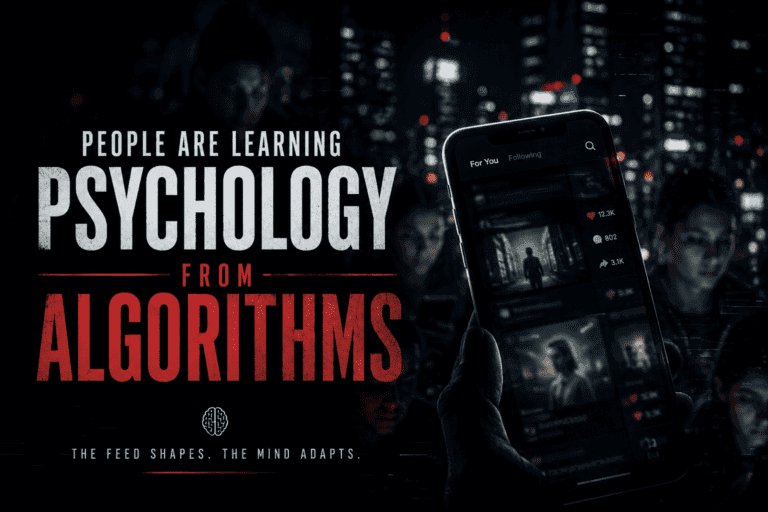
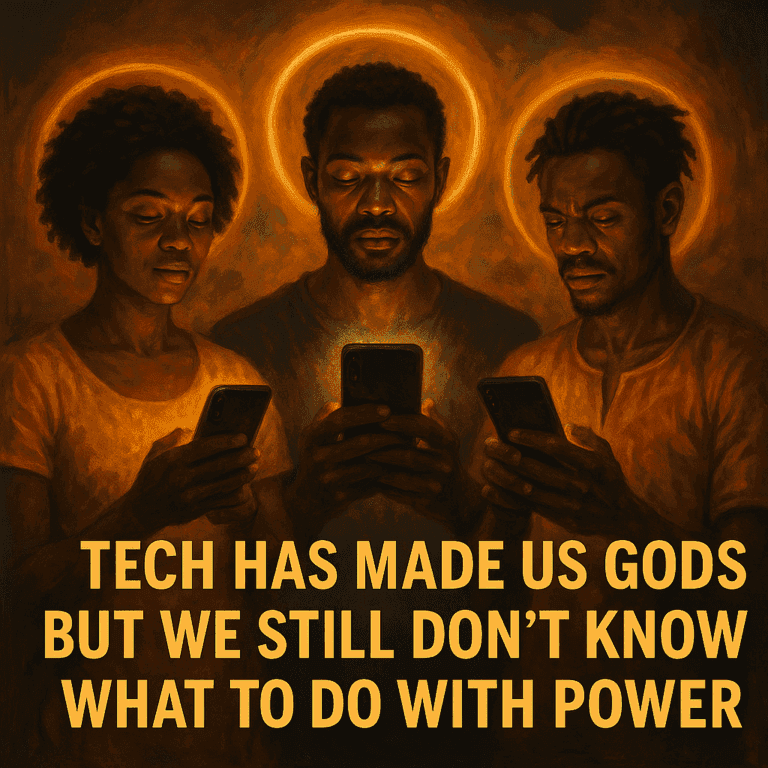
Tech has made us gods. We live in a time where you can literally summon someone with a text, move money with a tap, and build things that once took entire companies, all from the small rectangle in your hand.
That’s wild when you think about it. Somewhere between 3G and GPT, we quietly slipped into a new era—where ordinary people hold extraordinary power. But here’s the twist: the more powerful we’ve become, the more powerless we often feel.
We can talk to anyone but barely know how to talk to ourselves.
We can automate tasks, but not our discipline.
We can generate art but still can’t generate meaning.
Technology gave us the abilities of gods but not the wisdom to handle them.
We can shape the world now, but we’ve lost the patience to understand it.
The Paradox of Power in the Digital Age
Every scroll feels like creation.
Every post feels like progress.
We’re doing something clicking, typing, and sharing, and it feels like movement.
But deep down, we know most of it is noise.
We’ve made effort easy, but discipline is still hard.
We’ve gained reach but lost reflection.
We’ve built apps to think for us and then started feeling disconnected from our own thoughts.
It’s crazy how we confuse being busy with being alive.
Somewhere between dopamine and data, we mistook capability for clarity.
We’re drowning in options but starving for meaning.
We can do anything now, but we no longer know what’s worth doing.
The Rise of the New Gods
Remember how ancient gods ruled through mystery?
They asked for faith and promised meaning.
Well, our new gods don’t need temples—they have apps.
They don’t ask for prayers—they ask for engagement.
We open our phones like sacred texts, checking for signs —
notifications, messages, and numbers that tell us if we still matter.
Every like feels like a small blessing.
Every algorithmic push feels like divine favor.
We worship convenience now.
And in the process, we replaced mystery with metrics.
We no longer ask for purpose—we ask for Wi-Fi.
The Mirror We Built
Let’s be honest—tech isn’t evil. It’s just a mirror. It reflects everything we desire, our fears, and our impatience. We made technology from our human image: fast, curious, brilliant, inconsistent, and restless.
When you stare into your screen, you’re not looking at artificial intelligence—you’re looking at amplified humanity.
Our chaos.
Our creativity.
Our search for meaning in a world moving too fast for wisdom to catch up.
So maybe the problem isn’t what’s on the screen.
Maybe it’s the reflection staring back.
The Meaning We’ve Misplaced
The internet didn’t steal our peace—it just revealed how little we had.
AI didn’t take our creativity—it showed how fragile our originality was.
Maybe the problem isn’t that we have too much technology.
Maybe it’s that we have too little philosophy.
We build faster.
Connect faster.
Post faster.
But rarely stop to ask why.
Because wisdom doesn’t scale.
Patience doesn’t update.
And meaning?
Meaning isn’t downloadable.
And yet, those are the very things that make power worth having.
Finding Balance in the Machine
Maybe real progress now isn’t about faster chips or smarter code. Maybe it’s about slowing down long enough to understand what we’re actually building and who we’re becoming while building it.
The real evolution might not be machines learning to think like humans. But humans are learning to think again because technology isn’t the villain—it’s our reflection, and if we don’t like what we see, maybe it’s time to adjust the reflection.
We don’t need less technology; we need more self-awareness.
We don’t need to unplug; we need to reconnect, differently.
We don’t need to stop creating; we just need to remember why we started.
📘 External reference: The Future of Soul and Machine: Finding Balance in the Age of AI
Final Thought on Tech and Power
We’ve mastered creation. Maybe it’s time we relearn contemplation because power without purpose isn’t progress—it’s noise. In this age of algorithms and endless updates, maybe the bravest thing we can do is pause and think.