
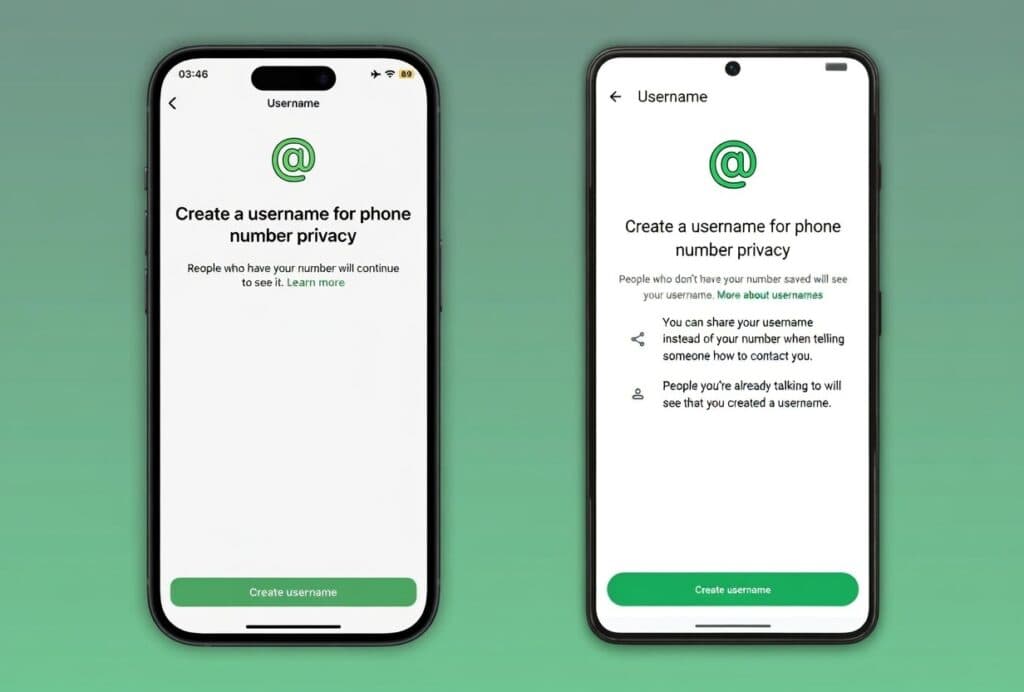
WhatsApp username vs phone number is no longer just a technical feature debate.
It has quietly become one of the most important identity questions of this decade.
For more than ten years, your phone number was your WhatsApp identity.
It carried your real name, your social network, your reputation—and most importantly, real-world accountability.
If someone had your number, there was usually no doubt that a real person existed behind the screen.
That equation is now changing—permanently.
WhatsApp usernames introduce a new identity layer, and the official promise sounds appealing:
-
Stronger privacy
-
Frictionless connections
-
Less personal exposure
But every major shift in identity comes with trade-offs that are rarely obvious at first.
Most users accept usernames without pausing to ask what they are quietly giving up.
This article is not here to crown a winner.
Its purpose is simpler—and harder: to expose the real comparison beneath the feature update.
Convenience vs. control.
Privacy vs. ownership.
Speed vs long-term agency.
The Phone Number Era: Why It Actually Worked (Despite Its Flaws)
Before usernames, WhatsApp kept identity brutally simple.
Your phone number:
-
Anchored your digital presence to the physical world
-
Created automatic accountability—people could call, trace, or verify you
-
Made large-scale spam and impersonation significantly harder
-
Accelerated trust, especially in high-context societies
Across Africa—Nigeria, Kenya, Ghana, South Africa—phone numbers were never just digits.
They functioned as social proof, business cards, family lifelines, and market credentials all at once.
A WhatsApp account without a visible number would have felt abstract, distant, and even suspicious.
Yes, the system had friction.
But that friction enforced responsibility.
And responsibility is how trust is built.
What WhatsApp Usernames Really Change
With usernames, users can now:
-
Start conversations without sharing their phone number
-
Be discovered via public @handles
-
Connect without exposing personal contact details
At first glance, this looks like pure progress.
And for many everyday scenarios, it genuinely is.
But beneath the surface, the shift is profound.
Your identity becomes:
-
Fully platform-mediated
-
Detachable from real-world verification
-
Editable, suspendable, or reclaimable by policy
-
Ultimately more fragile
The deeper question is not what usernames enable.
It is what they quietly replace.
WhatsApp Username vs Phone Number: The Real Trade-Off
| Aspect | Phone Number | WhatsApp Username |
|---|---|---|
| Identity ownership | You truly own it | Platform ultimately controls it |
| Discoverability | Very limited | Broad and searchable |
| Trust & accountability | High | Context-dependent |
| Privacy type | Physical exposure | Platform-managed |
| Portability | SIM-based, stable | Platform-based, conditional |
| Impersonation risk | Lower | Significantly higher |
| Account recovery | Telco support | Policy-driven |
This is not a design preference.
WhatsApp username vs phone number is a powerful decision.
Privacy Is Not the Same as Ownership
Usernames undeniably improve privacy.
But privacy and ownership are not the same thing.
Hiding your phone number does not erase your digital footprint.
It simply transfers control of that footprint—from you to the platform.
With usernames:
-
Trust becomes platform-mediated, not person-to-person
-
Identity can be restricted, rate-limited, or erased by policy
-
Discovery becomes algorithmic rather than relational
-
You gain short-term safety at the cost of long-term dependency
Most product announcements avoid discussing dependency.
They don’t need to—but users should.
Convenience Always Has a Price
Usernames eliminate friction:
-
Share a handle instead of saving numbers
-
Onboard contacts instantly
-
Reduce unsolicited exposure
But systems that reduce friction almost always:
-
Centralize power
-
Weaken individual leverage
-
Prioritize platform scale over user sovereignty
When identity becomes flexible, it also becomes breakable.
Consider the delayed questions:
-
What happens when your desired username is taken?
-
What if your account is restricted or deleted?
-
What if impersonation becomes effortless?
-
What if disputes are resolved by algorithms, not humans?
Phone numbers were inconvenient—but that inconvenience protected users more than it irritated them.
Who Actually Benefits From This Shift?
Users gain:
-
Cleaner interactions
-
Reduced spam surface
-
A stronger sense of privacy
WhatsApp / Meta gains:
-
Higher discoverability and network effects
-
Richer social graph data
-
Easier cross-platform integration
-
Reduced dependence on telecom operators
This isn’t a conspiracy.
It’s business alignment.
The Cost People Only Notice Later
The true downside of WhatsApp usernames vs. phone numbers doesn’t appear on launch day.
It shows up quietly, over time:
-
When impersonation becomes common
-
When account recovery becomes impossible
-
When support turns automated
-
When trust is assumed instead of earned
Phone numbers tied identity to real-world consequence.
Usernames tie identity to platform policy.
That single contrast explains almost everything.
Why This Matters More in Africa and Emerging Markets
In societies where:
-
Trust is built person-to-person
-
Accountability outweighs aesthetics
-
Institutions are unreliable
-
Human support still matters
Fully abstract identity systems face resistance.
Usernames can succeed—but only if they earn legitimacy, not demand it.
The most successful African systems don’t erase reality.
They build on top of it.
Final Question: Ease or Agency?
WhatsApp usernames are not evil.
Phone numbers are not sacred.
But every identity system answers one unavoidable question:
Who holds power when something goes wrong?
-
If you value speed, convenience, and surface-level privacy → usernames win.
-
If you value ownership, accountability, and long-term control → phone numbers still matter.
Technology keeps selling comfort.
Comfort always arrives with conditions.
The smartest users no longer ask, “What’s new?”
They ask the harder question:
“What am I giving up?”
Technology is the easy part.
Understanding power, trust, and human incentives remains the difficult one.
WhatsApp username vs phone number is no longer a technical comparison.
It is a mirror—reflecting the kind of digital identity you are choosing to live inside.