Economic survival skills have become a growing concern in a world shaped by recessions, technological disruption, inflation, and uncertainty. Yet history shows that some skills continue to create value regardless of the economic climate.
Every generation believes its crisis is unique.
The Great Depression.
The Oil Crisis.
The Dot-Com Crash.
The 2008 Financial Crisis.
The COVID-19 pandemic.
The rise of artificial intelligence. Different eras. Different technologies. Different headlines. Yet history reveals something fascinating. While industries collapse, markets crash, and technologies change, certain human skills continue to create value.
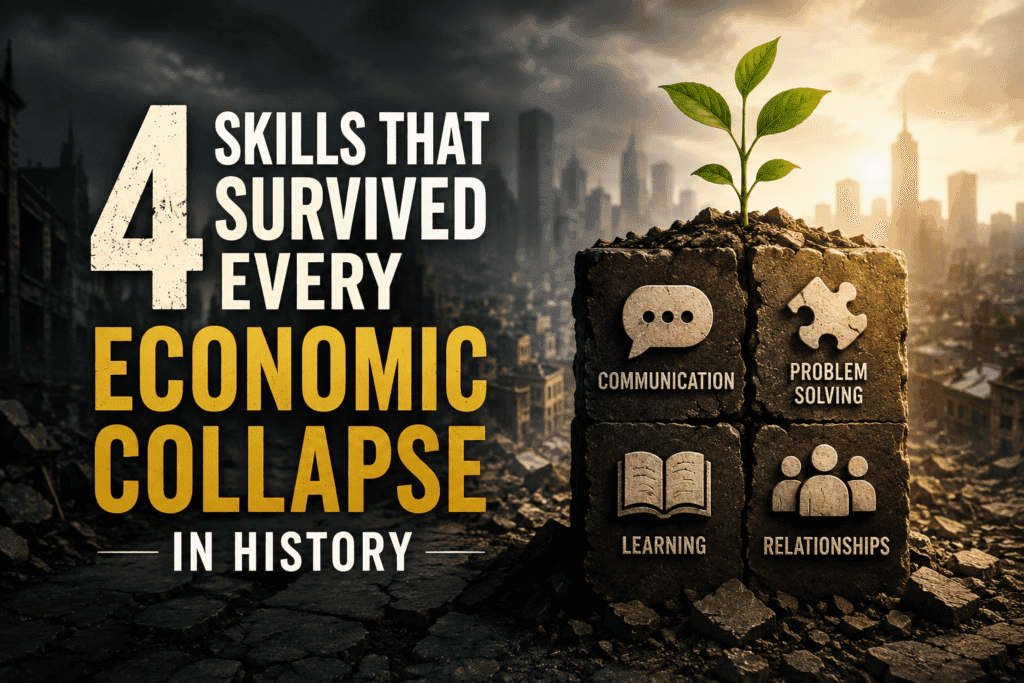
The tools change, the skills endure, and looking across centuries of economic disruption, four abilities consistently survived every downturn.
1. The Ability to Communicate
Long before the internet, people who could communicate effectively held an advantage. They could persuade, they could negotiate, they could teach, and they could sell. In difficult economic times, opportunities often belong to those who can clearly express ideas and build trust with others.
A farmer who could negotiate survived, a merchant who could persuade survived, and a business owner who could communicate value survived. Technology changes how we communicate; it does not eliminate the need for communication, and in many ways, communication becomes even more valuable when uncertainty increases.
2. The Ability to Solve Problems
Every economic collapse creates new problems, and every new problem creates demand for solutions. The people who survive are rarely those who complain the loudest.
They are often the people who adapt the fastest, and problem-solvers create value because they reduce pain, remove friction, and improve outcomes.
Whether through engineering, medicine, design, entrepreneurship, or craftsmanship, the ability to solve meaningful problems remains one of the most recession-resistant skills in history.
The world may stop rewarding certain jobs; it rarely stops rewarding useful solutions.
3. The Ability to Learn
History has never been kind to people who refuse to adapt; entire professions have disappeared, entire industries have transformed, and technologies have become obsolete. Yet people who continuously learn often find ways to reinvent themselves.
The ability to learn may be the ultimate survival skill because learning is the skill that allows every other skill to evolve.
A person who can learn can acquire new tools.
A person who can learn can enter new industries.
A person who can learn can recover from disruption.
In a rapidly changing world, adaptability often matters more than expertise.
4. The Ability to Build Relationships
Economic collapses are not only financial events; they are social events, and opportunities frequently travel through people’s recommendations, introductions, partnerships, collaborations, and communities.
Throughout history, strong relationships have opened doors during difficult times. Trust becomes especially valuable when resources become scarce. People tend to do business with those they trust, they tend to support those they know, and also they tend to remember those who helped them when times were difficult.
Networks do not replace competence. But competence becomes far more powerful when combined with relationships.
What History Really Teaches
When economies collapse, many people focus on what disappears.
Jobs disappear.
Companies disappear.
Markets disappear.
Technologies disappear.
But history suggests a better question:
What remains?
Communication remains.
Problem-solving remains.
Learning remains.
Relationships remain.
These skills survived agricultural economies.
They survived industrial economies.
They survived information economies.
And they will likely survive whatever comes next.
Final Thoughts
Economic collapse changes the landscape.
It does not change human nature.
People will still need solutions.
People will still need trust.
People will still need ideas.
People will still need connection.
The tools of value creation evolve with every generation.
But the foundations remain remarkably consistent.
Perhaps the safest investment is not a stock, a trend, or a technology.
Perhaps the safest investment is building skills that history has already tested.
You might also be interested in: Why Gen Z Doesn’t Trust Luxury Like Millennials Did
You might also be interested in: Early Success Is a Scam. Great Things Take Time.