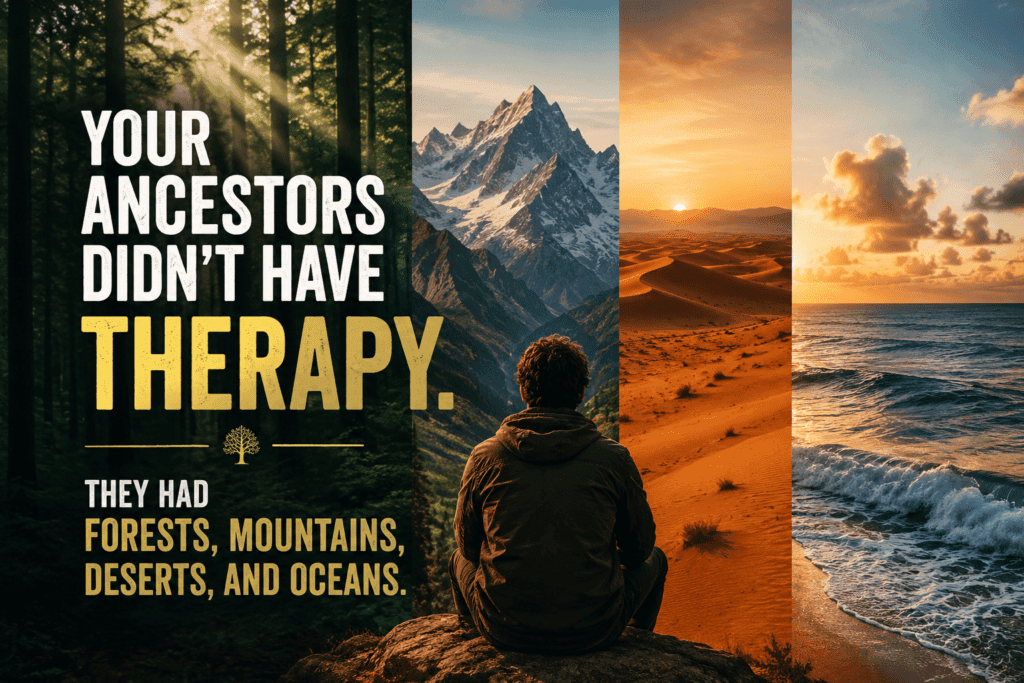
Your ancestors didn’t have therapy. They had forests, mountains, deserts, and oceans.
There is a sentence I cannot stop thinking about:
At first glance, the statement sounds provocative, while some people may hear it as an attack on modern psychology. Others may interpret it as nostalgia for a simpler past.
I see it differently. To me, it is not a criticism of therapy. It is a reminder of something we have forgotten. A reminder that for most of human history, healing was not something people scheduled into their calendars.
It was woven into the way they lived.
Before We Had Experts, We Had Environments
Modern people often search for healing through specialists; when we are overwhelmed, we seek advice. When we are anxious, we seek explanations. When we are lost, we seek guidance, and there is nothing wrong with that.
In many cases, it is necessary. But our ancestors lived in a different world, a world where there were no notifications. No endless feeds and no constant comparison.
No twenty-four-hour cycle of information competing for attention. They lived inside environments that naturally created moments of reflection.
The forest slowed them down.
The mountains humbled them.
The desert taught patience.
The ocean taught surrender.
Nature was not an escape from life.
Nature was life.
The Forest Was a Place to Meet Yourself
Today, silence makes many people uncomfortable. We fill empty moments with podcasts, music, videos, and endless scrolling.
Our ancestors had something different. They had it quiet, and the forest was more than a collection of trees. It was a place where distractions disappeared. A place where a person could hear their own thoughts and a place where problems could be examined without interruption.
Many of us spend our lives trying to escape ourselves, while the forest forces people to meet themselves, and perhaps that is why it was healing. Because healing often begins with honesty.
Mountains Remind Us That We Are Not the Center of the Universe
There is a reason people climb mountains during moments of transformation. A mountain changes perspective. Standing before one has a strange effect on the human mind.
Suddenly, the things that seemed overwhelming begin to shrink; so does the argument that ruined your day. The insecurity that consumed your thoughts and the fear that kept you awake.
Against the backdrop of a mountain, these things look smaller. Not because they are unimportant. But because nature reminds us that our problems are only part of a much larger story.
Modern life often traps us inside ourselves.
Mountains pull us outside of ourselves.
The Ocean Understands What Humans Struggle to Accept
Few things are as therapeutic as sitting beside the ocean. Not because the ocean solves problems. But because it teaches a lesson, many of us resist.
Everything moves, everything changes, and everything passes. The wave that crashes against the shore does not remain there forever.
It comes, it goes. and another follows.
The same is true for emotions.
The same is true for disappointment.
The same is true for grief.
Yet modern people often attempt to control everything; we hold onto what should be released. We replay what should be accepted. We resist what cannot be changed. The ocean teaches surrender without saying a word.
The Desert and the Value of Stillness
The desert may be the most misunderstood landscape of all. Many people see emptiness, and ancient cultures often saw wisdom. The desert strips away excess. There are no distractions and no noise.
No unnecessary abundance. Only essentials, and perhaps that is why so many spiritual traditions contain stories of deserts. Because transformation often requires removing what is unnecessary.
Modern life encourages accumulation.
More information.
More possessions.
More entertainment.
More stimulation.
The desert asks a different question: What remains when everything unnecessary disappears?
What Modern Life Replaced Nature With
This is where things become interesting. Human beings never stopped searching for relief. We simply changed where we looked for it.
The forest became social media, the mountain became status, the ocean became entertainment, and the desert became consumption.
We replaced experiences with substitutes.
Connections became followers.
Community became algorithms.
Reflection became content.
Silence became noise.
And yet many people have never felt more anxious, distracted, or disconnected. Perhaps the problem is not that modern life is wrong. Perhaps the problem is that modern life is incomplete.
This Is Not an Argument Against Therapy
Let me be clear. Therapy matters.
Mental health professionals save lives.
Many people need support that nature alone cannot provide.
This article is not suggesting otherwise.
The point is not to choose between therapy and nature.
The point is to recognize that healing has always been bigger than one solution.
A conversation can help.
So can a walk.
A therapist can help.
So can a sunset.
Professional guidance can help.
So can sitting quietly beneath a tree for an hour without checking your phone.
The healthiest future may not be found in choosing one over the other.
It may be found in combining both.
What Our Ancestors Understood
Across continents and cultures, people developed rituals that connected them to the natural world. They watched the seasons, they observed the stars, and they understood the rhythms of rivers.
They paid attention to sunrise and sunset. Not because they were less intelligent than we are. But because they recognized something fundamental.
Human beings are not separate from nature. We are part of it.
The same earth that grows forests grows us.
The same water that fills oceans fills our bodies.
The same cycles that govern seasons also govern life.
When we disconnect from nature completely, we disconnect from something within ourselves.
The Forgotten Need
Perhaps the greatest challenge of modern life is not stress.
It is disconnection.
Disconnection from community.
Disconnection from silence.
Disconnection from stillness.
Disconnection from the natural world.
And ultimately, disconnection from ourselves.
We have become incredibly connected technologically.
Yet many people feel profoundly alone.
We know what is happening everywhere.
Yet we struggle to understand what is happening within.
That is not a technological problem.
It is a human one.
Final Thoughts
Your ancestors didn’t have therapy.
They had forests.
They had mountains.
They had deserts.
They had oceans.
More importantly, they had a relationship with the world around them. A relationship that constantly reminded them that they were part of something larger than themselves.
Modern life has given us extraordinary tools. But it has also convinced us that healing exists somewhere outside of us. Maybe healing is not always found in another app.
Another video.
Another notification.
Maybe sometimes it is found in a walk.
A tree.
A river.
A sunrise.
A moment of silence.
Because long before humanity created algorithms, nature was already teaching lessons about balance, perspective, patience, and peace. The question is not whether nature still speaks.
The question is whether we are quiet enough to hear it.