
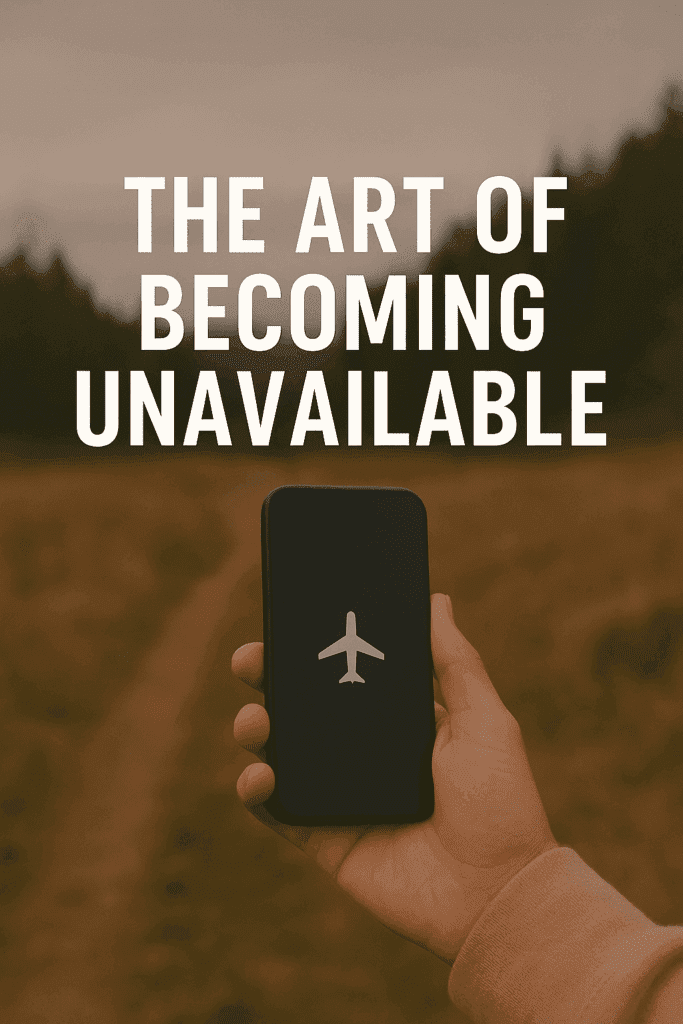
The Art of Becoming Unavailable is not about ghosting people — it’s about guarding your peace. There’s a strange guilt that follows when you don’t reply instantly — a tension between peace and pressure. Someone texts you, and before your mind even processes it, your thumb is already hovering over reply.
We’ve become so used to being reachable that rest feels rebellious. But here’s the truth: you cannot be fully present and fully available at the same time.
📱 The Art of Becoming Unavailable in the Age of Constant Pings
We live in an era where silence is suspicious. If you don’t post, people assume something’s wrong. If you don’t respond, you’re “acting different.”
Our lives now move at notification speed — WhatsApp, Slack, X, Instagram, email — even the quiet of our thoughts interrupted by a buzz.
The world keeps saying, “Stay connected.”
But connection without boundaries becomes chaos. Somewhere between our blue ticks and “seen” receipts, we lost The Art of Becoming Unavailable — the sacred distance that allows you to step away without disappearing.
🌍 Technology Made Us Present, Not Peaceful
Technology promised convenience, but what it gave was exposure. We’ve built networks so vast that we forgot how to log out of ourselves.
Even your phone has Do Not Disturb mode.
Apps crash when they run too many processes. Servers throttle requests to avoid overload.
So why do you, the most sophisticated system in existence, think you can handle everyone all the time?
Being unavailable isn’t laziness — it’s emotional load balancing.
💡 The Real Definition of Availability
Availability isn’t about access — it’s about priority. It’s not refusing people; it’s refusing pressure.
It’s not cutting people off; it’s cutting distractions out. The Art of Becoming Unavailable isn’t anti-social — it’s pro-sanity.
It’s saying:
“I will not be everywhere. I will not be everything. But where I am, I will be whole.”
That’s not selfishness — that’s maturity.
💻 Tech as a Mirror: What Systems Teach Us
Let’s take it back to tech — because that’s how we understand life now.
Your favorite platforms run on uptime and downtime. Even the biggest servers go offline for maintenance.
They disconnect to stay reliable.
So what makes you think you’ll burn out less by being “always on”?
Humans need scheduled downtime too — time to reboot your soul, defragment your thoughts, and update your boundaries.
For further reading, check out Cal Newport’s thoughts on Digital Minimalism.
🕯️ How to Practice The Art of Becoming Unavailable
- Uninstall urgency.
Not everything needs an instant response. Let silence speak sometimes. - Set invisible boundaries.
You don’t owe everyone an update — you owe yourself peace. - Choose fewer rooms.
You can’t be present in every group, trend, or conversation. Energy is currency — spend it wisely. - Redefine productivity.
You’re not lazy when you rest; you’re being strategic with your sanity. - Return softer, not louder.
When you reappear, come back with clarity, not chaos.
🌤️ The Beauty of Absence
Sometimes, disappearing is the most honest way to show up for yourself. Because in absence, we find alignment.
In silence, we find signal. The world doesn’t need more people shouting to be seen — it needs more people who know when to step back.
🧭 Final Thought on The Art of Becoming Unavailable
The Art of Becoming Unavailable isn’t about disappearing – it’s about discerning.
It’s not isolation; it’s insulation — protecting what keeps you whole in a world addicted to access.
So next time someone says, “You’ve been quiet lately,” smile and tell them:
“I’ve been logged into peace.”
Because in a world that’s always online, peace is the new luxury.
🔗 Internal Link Suggestion