Sweden didn’t build a robot fleet to clean its streets. It turned to birds.


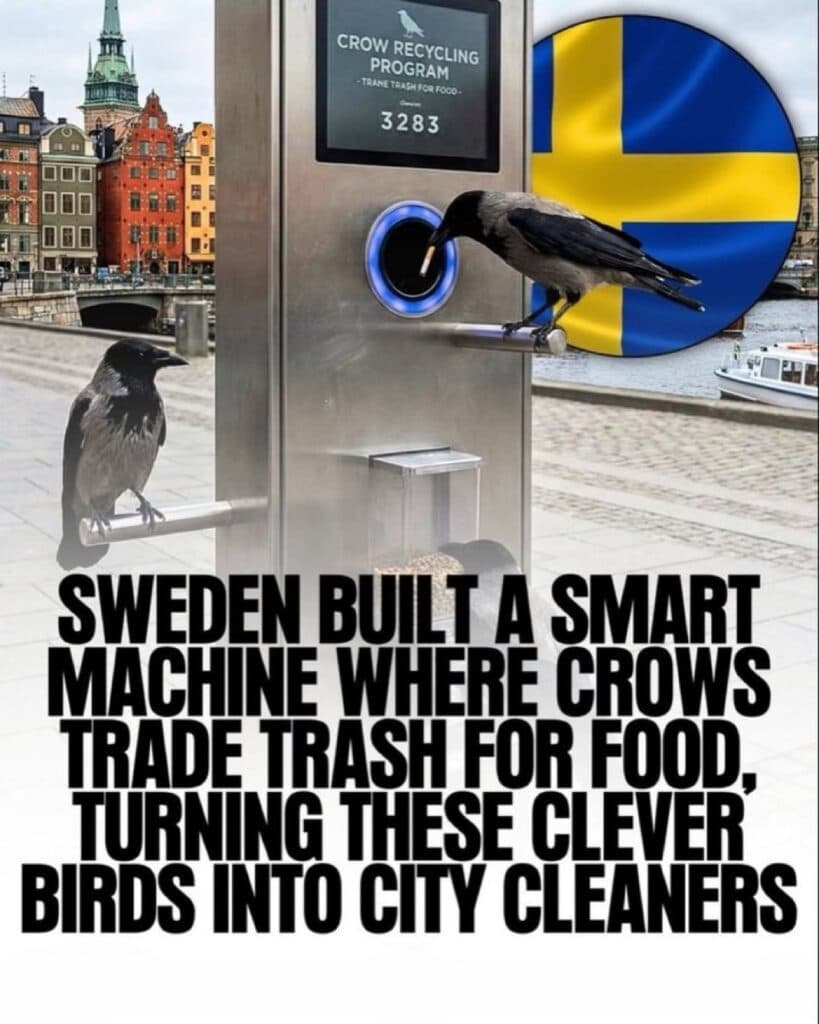
In Södertälje, just outside Stockholm, a startup called Corvid Cleaning launched a pilot that sounded like satire and operated like serious urban research: train wild crows to collect cigarette butts in exchange for food.
Not mascot birds. Not captive animals. Wild crows. Voluntary participation.
And for a moment, it worked.
The Problem No One Solves Well
Cigarette butts are the dominant form of street litter in Sweden. According to Keep Sweden Tidy Foundation, they account for roughly 62% of visible urban waste.
They’re small. Toxic. Non-biodegradable. And deceptively expensive to collect. Municipalities often spend between 0.80 and 2 Swedish kronor per butt — roughly 8 to 20 US cents. Multiply that across millions of discarded filters and the cleanup bill becomes a quiet drain on city budgets.
It’s a design problem disguised as sanitation. Humans drop them casually. Humans are reluctant to pick them up individually. Machines struggle with scale. Labor costs stack.
Corvid Cleaning looked at the street and saw a different workforce.
Why Crows?
Crows belong to the corvid family — widely regarded as among the most intelligent non-human animals on the planet. They use tools. They recognize faces. They remember specific human behaviors. They teach one another.
Their intelligence isn’t abstract. It’s practical.
Christian Günther-Hanssen, the founder of Corvid Cleaning, built a device that functioned like a vending machine for environmental service. A crow finds a cigarette butt, drops it into a slot, and the machine dispenses seeds or peanuts. Cameras and AI verify the object, rejecting leaves or debris to prevent “gaming” the system.
No cages. No force. The birds could approach or ignore it.
The premise was simple: reward collection behavior and let social learning do the rest.
Corvids are known to spread behaviors through observation. If one bird figures it out, others often follow. In theory, the system could scale itself.
Early demonstrations — including during Science Week in Södertälje around 2021–2022 — showed that the birds learned quickly. International outlets such as The Guardian and Reuters picked up the story. Videos circulated globally. The optics were irresistible: a crow hopping up to a sleek machine, dropping in litter, receiving payment.
It felt like a glimpse of a different kind of city.
The Economics Made Sense
Estimates suggested the model could reduce cleanup costs by up to 75%. That could bring per-butt expenses down to around 20 öre — roughly 2 US cents.
If accurate, that’s not incremental efficiency. That’s structural savings.
The machine wasn’t just a novelty. It was an attempt to reframe urban maintenance as a distributed system — leveraging animal intelligence to handle micro-tasks humans underperform at.
In an era obsessed with AI and robotics, this was a biological solution paired with smart verification hardware.
Low energy. Low infrastructure. High adaptability.
At least in theory.
The Friction Point
Then came the part that rarely trends: implementation.
Municipal collaboration didn’t materialize beyond pilot discussions. Financing proved uncertain. Ethical concerns surfaced, particularly around crows handling toxic nicotine residue from cigarette filters. Even if exposure levels were low, the optics and unknown long-term effects made public officials cautious.
Scaling a prototype requires more than proof-of-concept. It demands budget allocation, regulatory comfort, and risk tolerance.
Corvid Cleaning had attention. It didn’t have institutional momentum.
By late 2025, the company filed for bankruptcy. As of 2026, it has no active operations. The machines never became standard urban infrastructure.
The birds solved the task. The system stalled.
What This Actually Reveals
It’s easy to treat this as a quirky Scandinavian experiment that fizzled out. That misses the deeper signal.
Three things were demonstrated:
First, urban wildlife can meaningfully participate in structured environmental tasks when incentives align.
Second, positive reinforcement in intelligent species can produce scalable behavior through social transmission.
Third, cities are structurally conservative. Novel solutions face higher scrutiny than incremental spending on familiar inefficiencies.
The failure wasn’t technological. The machine worked. The birds learned. The economics were promising.
The friction was institutional and ethical.
And that’s where many sustainability innovations falter — in the gap between imagination and procurement.
The Bigger Question
What would it look like to design cities that collaborate with animal intelligence instead of merely managing it?
Urban falcons already control pigeon populations. Dogs detect disease and invasive species. Rats have been trained to locate landmines. Across the world, animals perform precision tasks humans struggle to execute efficiently.
The crow project forces a shift in perspective. Instead of viewing wildlife as a complication of urban life, what if it’s an underutilized asset?
That idea unsettles people. It complicates traditional boundaries between human systems and the natural world. It raises ethical considerations that must be addressed seriously.
But it also suggests something uncomfortable: sometimes nature outperforms our engineered systems at very specific tasks.
The question is whether institutions are flexible enough to integrate that reality.
A Proof of Possibility
Sweden did not permanently outsource its street cleaning to crows.
But for a brief moment in Södertälje, wild birds voluntarily cleaned cigarette butts in exchange for seeds, validated by a smart machine that recognized their contribution.
It wasn’t fantasy. It was operational.
That matters.
Because innovation isn’t always about scaling into dominance. Sometimes it’s about demonstrating that the boundary between “impossible” and “implementable” is thinner than assumed.
The streets still accumulate cigarette filters. The cleanup budgets still rise.
And somewhere in Sweden, the crows remain as intelligent as ever — problem-solvers without a contract.
The experiment didn’t take flight commercially. It did something else.
It proved the birds were ready.