Every year, Ojude Oba transforms Ijebu-Ode into a living canvas of culture.
The horses arrive.
The drums begin.
Families gather.
Generations reconnect.
The colors become impossible to ignore.
Photographers search for the perfect frame.
Social media fills with images that travel far beyond Nigeria.
But Ojude Oba was never created for Instagram.
Long before hashtags and viral moments, Ojude Oba existed as a gathering of gratitude, loyalty, and identity.
The festival traces its roots back to the 19th century when early Muslim converts in Ijebuland would gather after Eid celebrations to pay homage to the Awujale, the traditional ruler of the Ijebu people.
Over time, what began as a royal visit evolved into one of Africa’s most remarkable cultural celebrations.
Today, Ojude Oba is more than a festival.
It is a declaration.
A declaration that culture can survive modernity.
A declaration that tradition does not have to disappear in order for progress to exist.
A declaration that identity still matters.
And perhaps that is why one man unexpectedly became the symbol of this year’s celebration.
Not because he was trying to become famous.
But because he refused to become someone else.
The Man Everyone Was Looking At
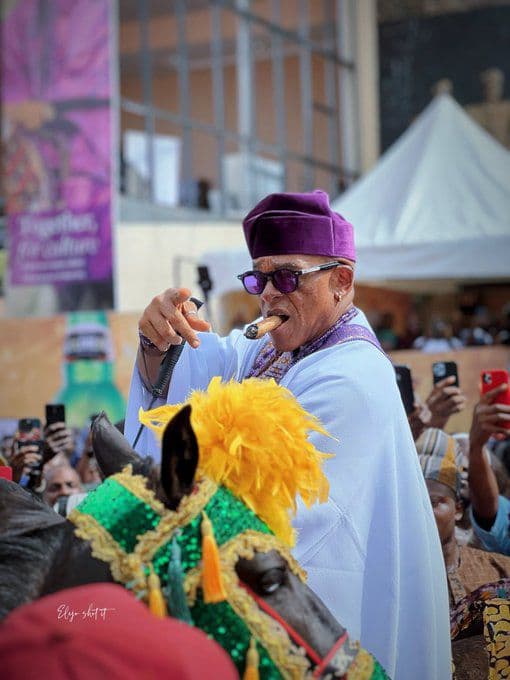
Among the horses, the regberegbe age groups, the royal displays, and the magnificent attire, one image captured the attention of millions.
A man on horseback.
Confident.
Calm.
Covered in tattoos.
Adorned with piercings.
Looking completely comfortable in his own skin.
That man was Farouq Oreagba.
Almost instantly, the internet became fascinated.
People admired the image.
They celebrated the confidence.
They reposted the photographs.
They turned him into an icon.
But what most people were reacting to was not the tattoos.
It was authenticity.
Because authenticity has become rare.
The Cost of Being Different
In a world obsessed with fitting in, being yourself can be expensive. Many people spend years editing themselves to gain acceptance.
They change how they dress.
They change how they speak.
They change what they believe.
They change who they are.
Not because they want to.
But because they are afraid.
Afraid of judgment.
Afraid of rejection.
Afraid of standing alone.
Farouq Oreagba’s story resonates because it reflects something many people understand. According to interviews and public discussions surrounding him, he has spoken about being judged for his tattoos and piercings in professional environments.
People questioned his appearance.
People made assumptions.
People viewed his image before they understood his character.
And yet he remained himself.
He did not redesign his identity to satisfy public expectations.
He stayed grounded.
He stayed authentic.
He stayed visible.
Years later, the same society that once questioned him is now celebrating him.
There is a lesson hidden inside that transformation.
Culture Is Not Uniformity
The biggest misconception about culture is the idea that everyone must look the same. Real culture has never been about uniformity. Culture is diversity inside belonging.
The strength of a people is not found in making everyone identical. It is found in creating enough room for individuality to exist without losing collective identity. That is why the image of Farouq Oreagba feels so powerful.
At first glance, he appears to represent modern individuality.
Tattoos.
Piercings.
Personal expression.
Yet at the same time, he is deeply connected to a cultural tradition that predates modern Nigeria itself. He is both modern and traditional, individual and collective. personal and cultural, and that balance is exactly what many young Africans are searching for.
The Africa Emerging Before Our Eyes
For decades, Africans were often told they had to choose between tradition and modernity. Choose between culture and globalization. Choose between heritage and self-expression.
But perhaps the future belongs to people who refuse that false choice, and the future belongs to people who understand that identity is not a prison.
It is a foundation.
A person can embrace technology and still honor culture.
A person can participate in global conversations and still remain rooted in local history.
A person can wear tattoos and still ride proudly in a centuries-old cultural celebration.
These things are not contradictions.
They are evidence that identity is evolving.
Why The World Connected With Him
The reason Farouq Oreagba became globally recognizable is not because people suddenly developed an interest in tattoos.
The reason is simpler.
People recognize courage.
Everyone has experienced judgment.
Everyone knows what it feels like to be misunderstood.
Everyone has felt pressure to become someone else.
When people saw him riding confidently through Ojude Oba, they were not only seeing a man.
They were seeing a possibility.
The possibility that a person can remain true to themselves and still belong.
The possibility that authenticity can survive criticism.
The possibility that individuality and culture can coexist.
What Ojude Oba Really Represents
This is why reducing Ojude Oba to fashion misses the point.
The clothing is beautiful.
The horses are magnificent.
The photographs are unforgettable.
But the festival represents something deeper.
Memory.
Identity.
Continuity.
Belonging.
Ojude Oba reminds us that culture is not something we inherit once.
It is something we actively choose to preserve.
Every generation decides whether the story continues.
Every generation decides whether the memory survives.
Every generation decides whether identity matters.
The Daddieshinor Perspective
Perhaps the greatest lesson from both Ojude Oba and Farouq Oreagba is this:
You do not have to abandon yourself to belong.
You do not have to erase your uniqueness to participate in culture.
You do not have to become a copy of everyone around you.
The strongest identities are not built through imitation.
They are built through acceptance.
Acceptance of who you are.
Acceptance of where you come from.
Acceptance of the story that shaped you.
Because when identity becomes secure, culture stops feeling like a costume.
It becomes a living part of who you are.
Final Thoughts
Long after the photographs fade and the conversations move on, one image from Ojude Oba will remain.
A man who refused to become someone else.
A festival that refused to disappear.
And a culture reminding the world that authenticity never goes out of style.
Perhaps that is why millions connected with the moment.
Not because it was fashionable.
Not because it was viral.
But because it revealed something many people spend their entire lives searching for:
The freedom to be fully yourself.
And the courage to let the world see it.